A heat dome, a week of wildfire smoke, and the wide circle of people working to help a nine-year-old breathe, from his bedside in Portland out to the scientists who study the fires.
This case is a journey. First, see how the people in Andre’s care are arranged around him. Then read his week straight through. Then walk his road: five stages, from the night in the emergency department out to the fire and the heat that started it. At most stops you will make a call before you read what the professional actually did.
Draft for review: the clinical story follows real pediatric asthma practice, and the career details are carefully researched and awaiting practitioner verification. Part One is illustrated as panels are finished.
Before you begin
Everyone stands somewhere around Andre
Every Compass Case sorts its people into four rings, arranged by how close their work brings them to the patient. Andre’s case reaches further out than most. Watch them appear.
Andre is at the center.
Press Continue to draw the first ring around him.
Systems, science & public health
Extended care team
Family & community
Direct clinical care
Part One · Andre’s Week
One hard week in late August
Read this once, straight through, before you meet anyone. Everything that follows grows out of it.
Who this is
Andre Mercado is nine. He lives with his mother Rosa, his little sister Lily, and his grandmother Elena in an apartment in the Cully neighborhood of Portland, Oregon. He has asthma, diagnosed when he was small, and on most days it is simply a fact about him. It is late August.
Monday · the heat arrives
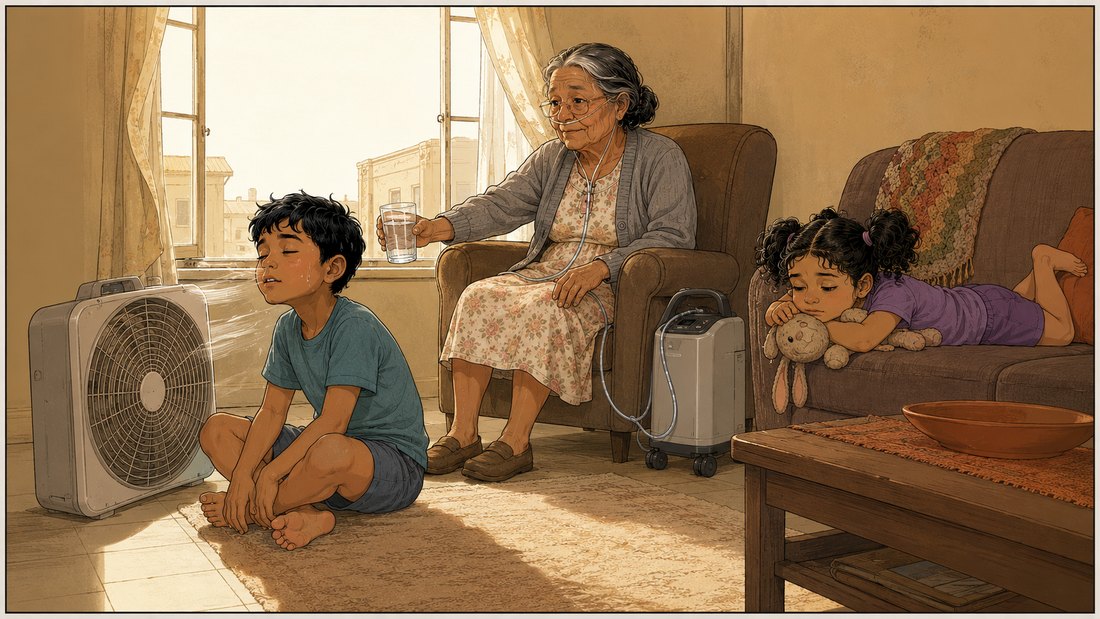
Andre wakes up already too warm. The apartment does not have air conditioning, and the fan in the window only moves the hot air around. His grandmother Elena, who has a lung condition called COPD, sits by the window with her portable oxygen and tells him to drink water. By afternoon the temperature outside hits 102 degrees. The forecasters are calling it a heat dome, a giant lid of high pressure parked over the Pacific Northwest, trapping the heat close to the ground.
Monday morning. No air conditioning, one window fan, and three generations waiting out the heat. Comic panel illustration, AI-generated.
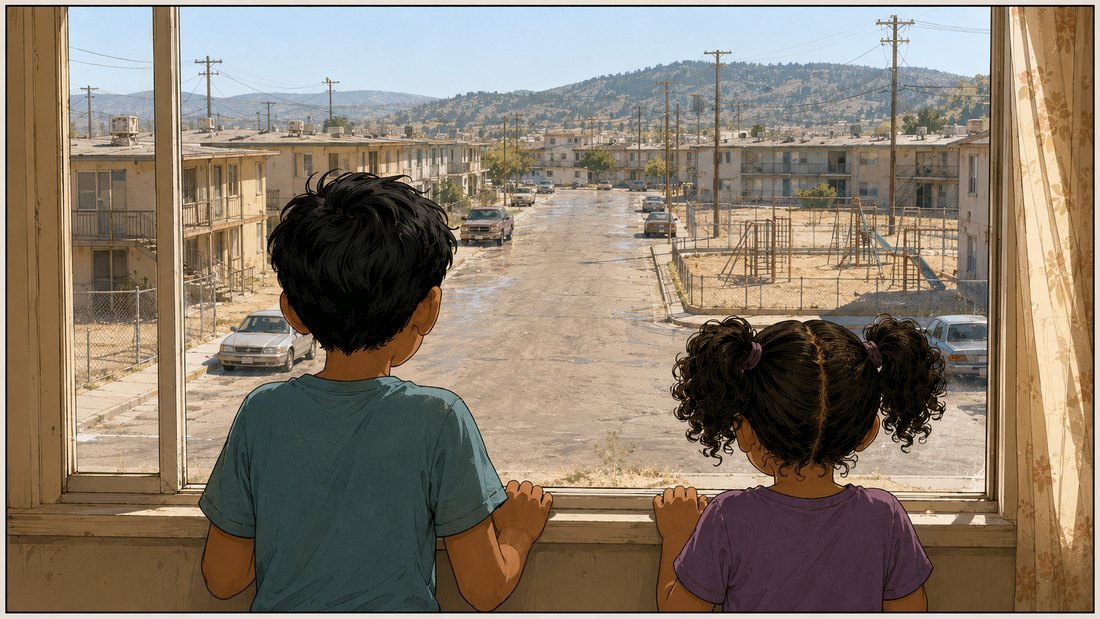
Andre and Lily are not allowed outside. The playground equipment is too hot to touch, and the streets in their neighborhood have very little shade. There are almost no big trees on their block, and the pavement and rooftops soak up the sun and radiate heat late into the night.
The block at 102 degrees. The playground is empty and there is nowhere shaded to stand. Comic panel illustration, AI-generated.
What is happening here
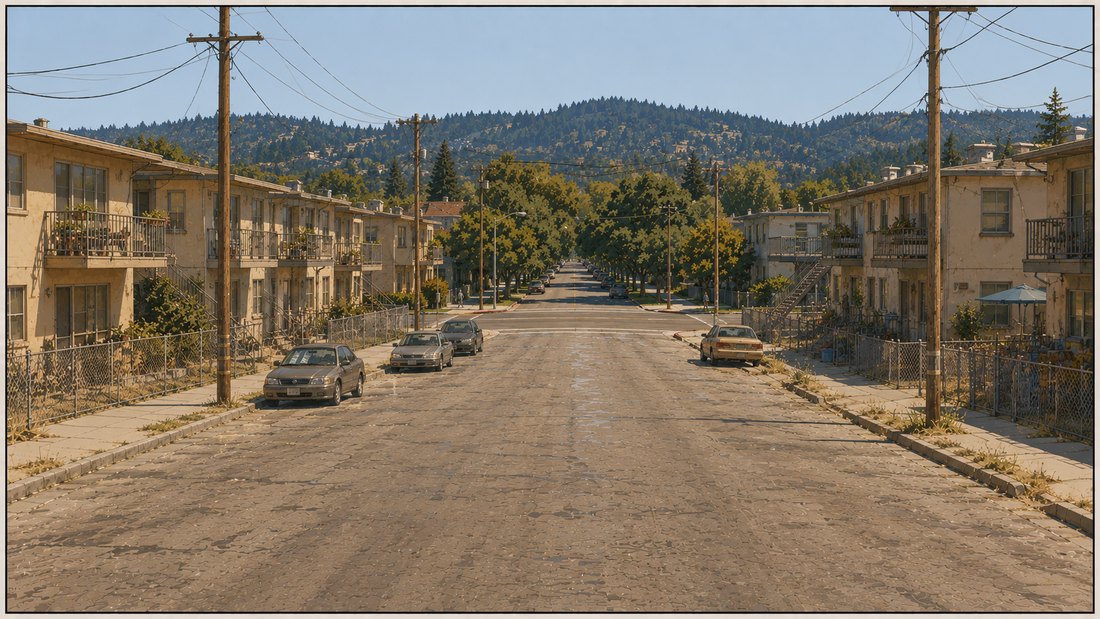
Andre’s neighborhood is several degrees hotter than the leafier, wealthier neighborhoods just a few miles away. That difference has a name: the urban heat island effect. Where there are more paved surfaces and fewer trees, the air stays hotter, and it stays hotter longer after sundown.
Two neighborhoods a few miles apart, and several degrees between them. Illustration, AI-generated.
A lens for your journey
Andre’s health is already being shaped before any doctor is involved. Where he lives, what his home is made of, whether his block has trees. Keep asking, as you read: who works on each of these things?
Wednesday · the smoke rolls in
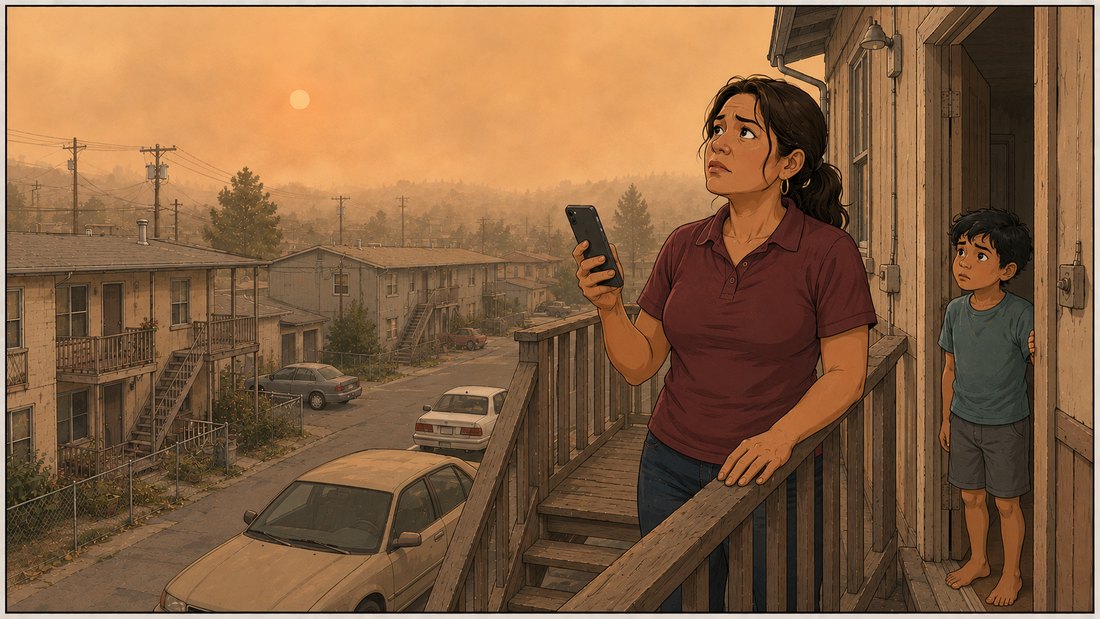
On Wednesday the sky turns a strange orange-brown. Wildfires are burning in the Cascade Mountains to the east, and the wind has shifted, pushing a thick blanket of smoke over the city. Rosa checks her phone. The air quality index, the AQI, has climbed past 200 into the purple zone. Purple means very unhealthy air, for everyone, not just people with breathing problems.
Wednesday. The wind shifts, and the smoke arrives from the Cascades. Comic panel illustration, AI-generated.
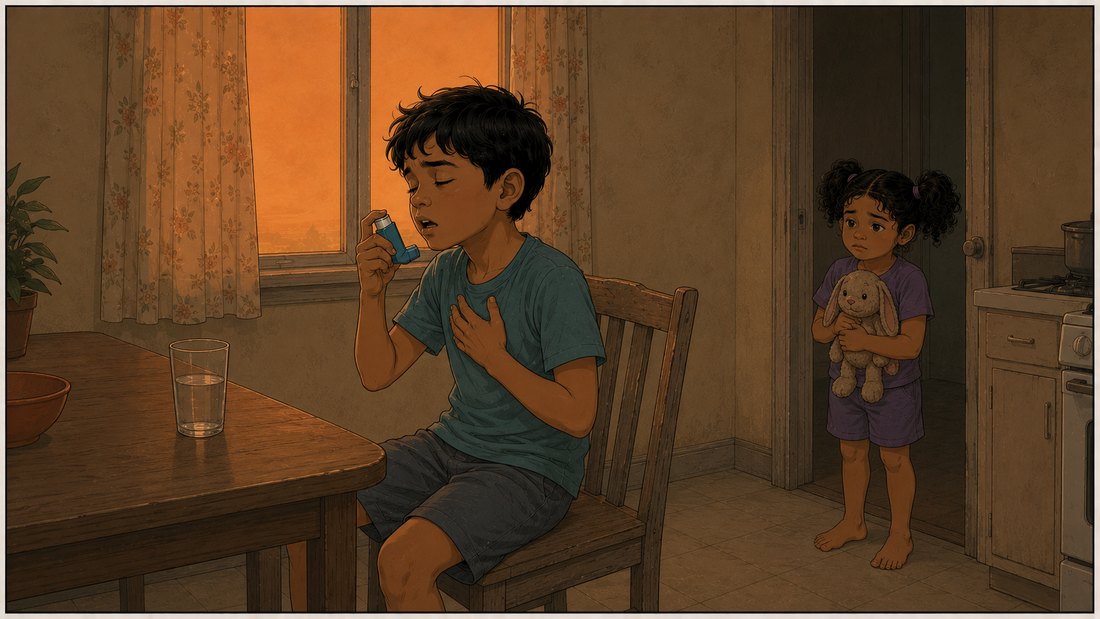
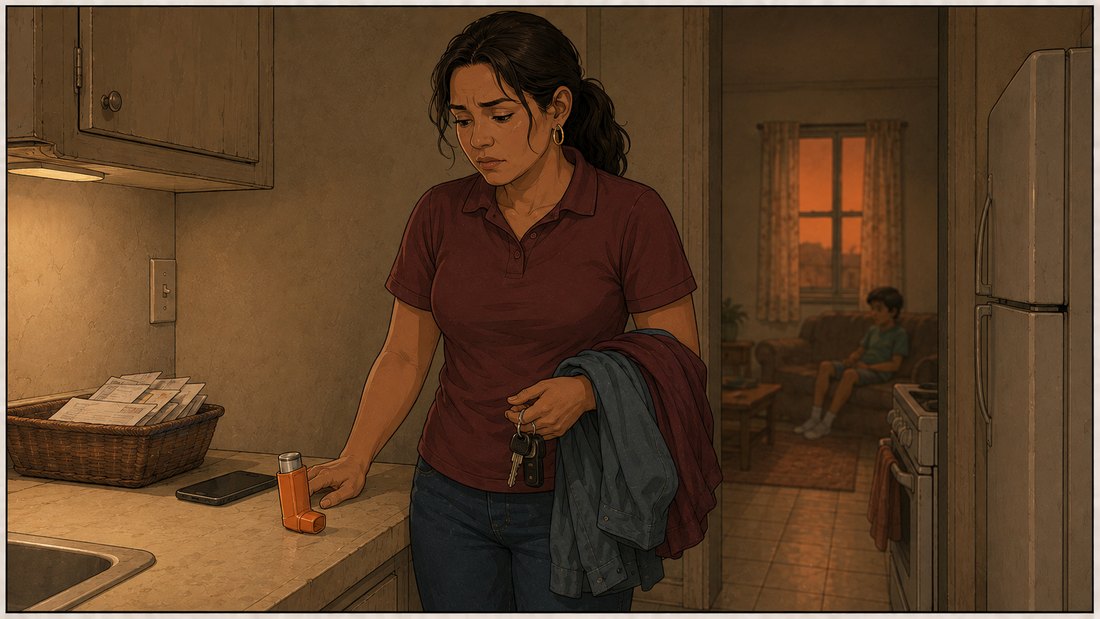
Andre starts to cough. It is a dry, tight cough at first. He uses his rescue inhaler, the blue one, and it helps for a while. His controller inhaler, the one he is supposed to take every morning to keep his asthma calm, ran out two weeks ago and Rosa has not been able to get to the pharmacy between her two jobs.
The blue inhaler still works, for a while. Comic panel illustration, AI-generated.
The controller inhaler ran out two weeks ago, between one job and the other. Comic panel illustration, AI-generated.
What is happening here
Wildfire smoke is full of tiny particles called PM2.5, so small they slip deep into the lungs. For a child with asthma, breathing that air is like sandpaper on already-sensitive airways. Heat and smoke together are worse than either one alone, because heat also raises ground-level ozone, another lung irritant.
A lens for your journey
Two of Andre’s triggers, the smoke and the heat, are arriving from far outside his home. Somebody is measuring that smoke. Somebody is studying why these fires are getting bigger. You will meet them later, in the outer ring of Andre’s world.
Thursday · the wheeze
By Thursday afternoon Andre’s cough has changed. Now there is a whistling sound when he breathes out, a wheeze, and he is breathing faster than usual. He tells his mom his chest feels tight, like someone is sitting on it. The rescue inhaler is not lasting as long as it used to. Rosa keeps him home and keeps the windows shut, but the apartment is stifling and some smoke has crept in anyway.
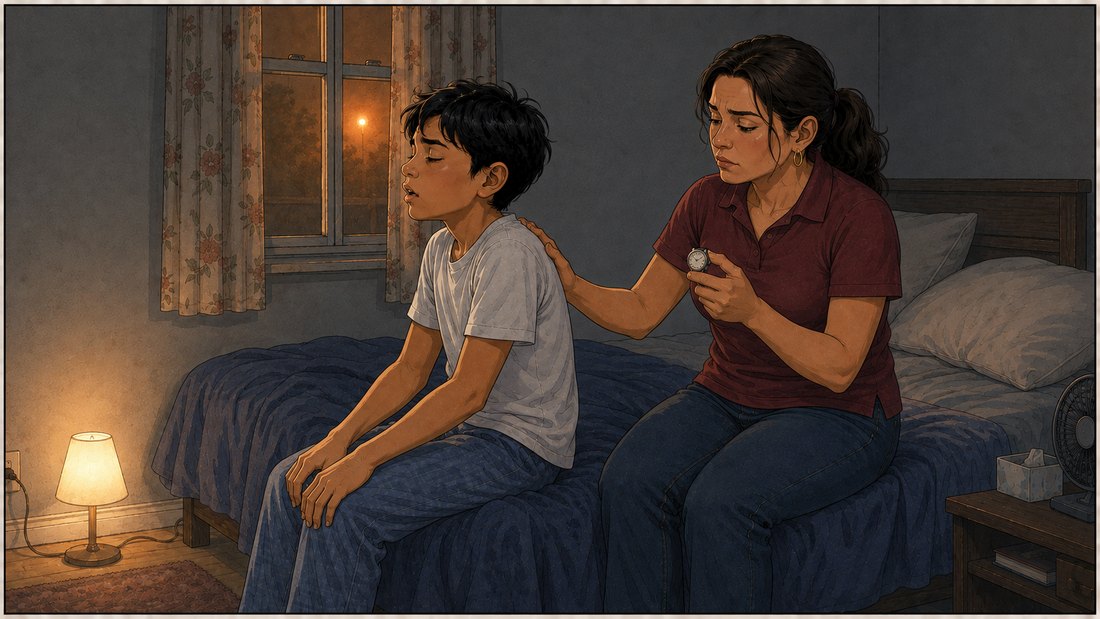
That night, Andre cannot lie down without coughing. He sits up in bed, shoulders hunched, working hard for each breath. Rosa counts his breaths and does not like the number. She notices the skin pulling in around his ribs each time he inhales.
Thursday night. Rosa counts his breaths, and does not like the number. Comic panel illustration, AI-generated.
What is happening here
The signs Rosa is noticing, fast breathing, a tight chest, skin pulling in between the ribs, are the body telling her that Andre’s airways are narrowing and he is having to fight for air. These are the signs clinicians are trained to read in seconds.
A lens for your journey
Rosa is doing careful clinical observation without a medical degree. Family members are always the first responders. Hold onto that as you meet the professionals.
Friday · the emergency department
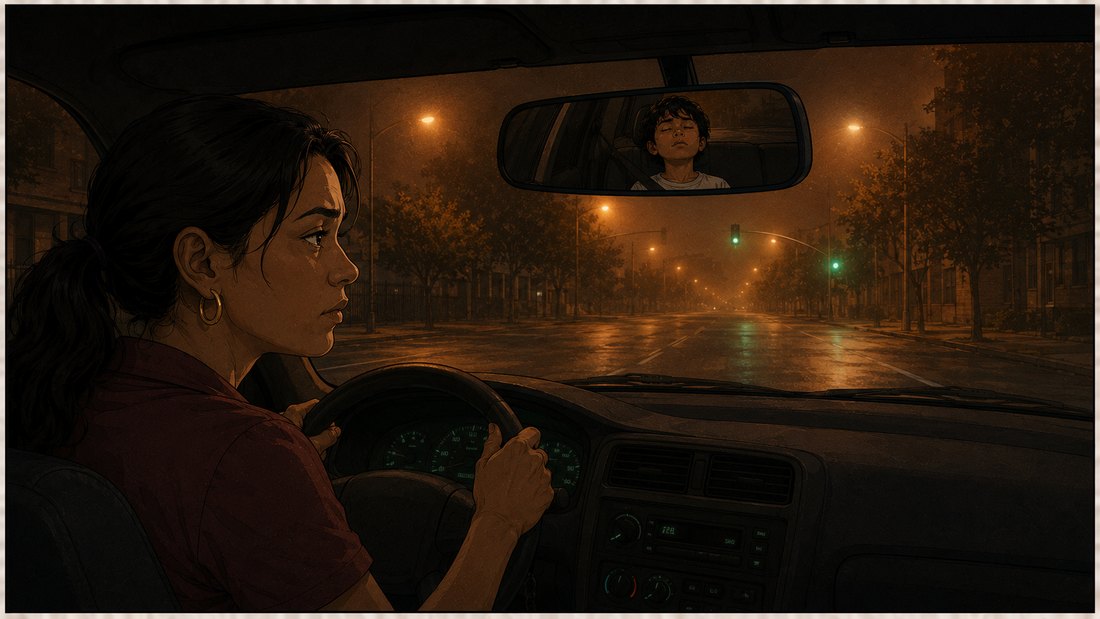
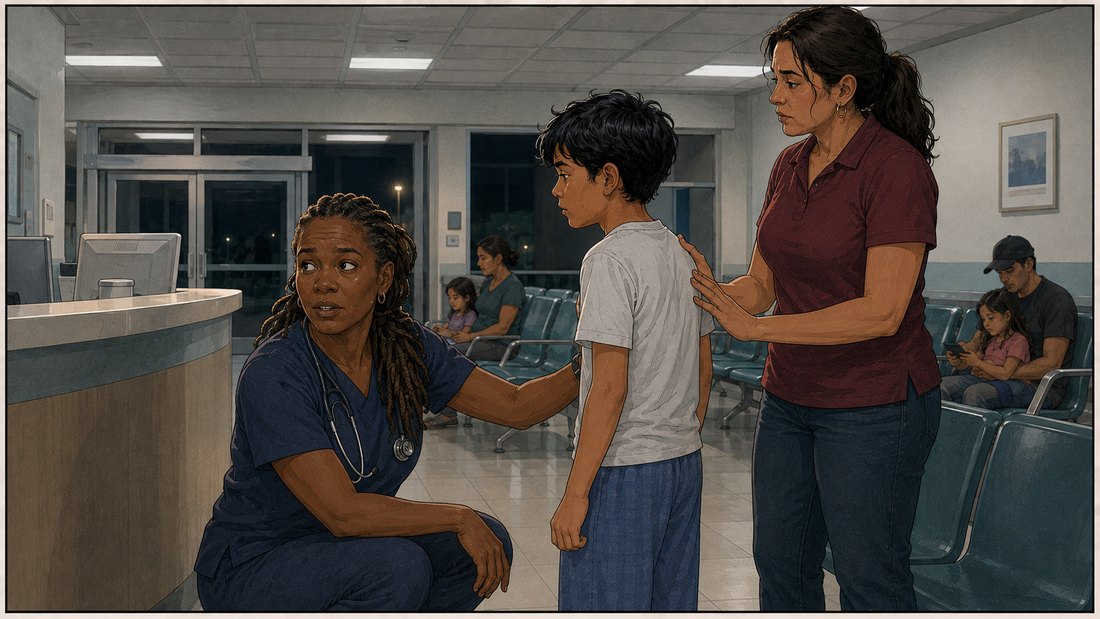
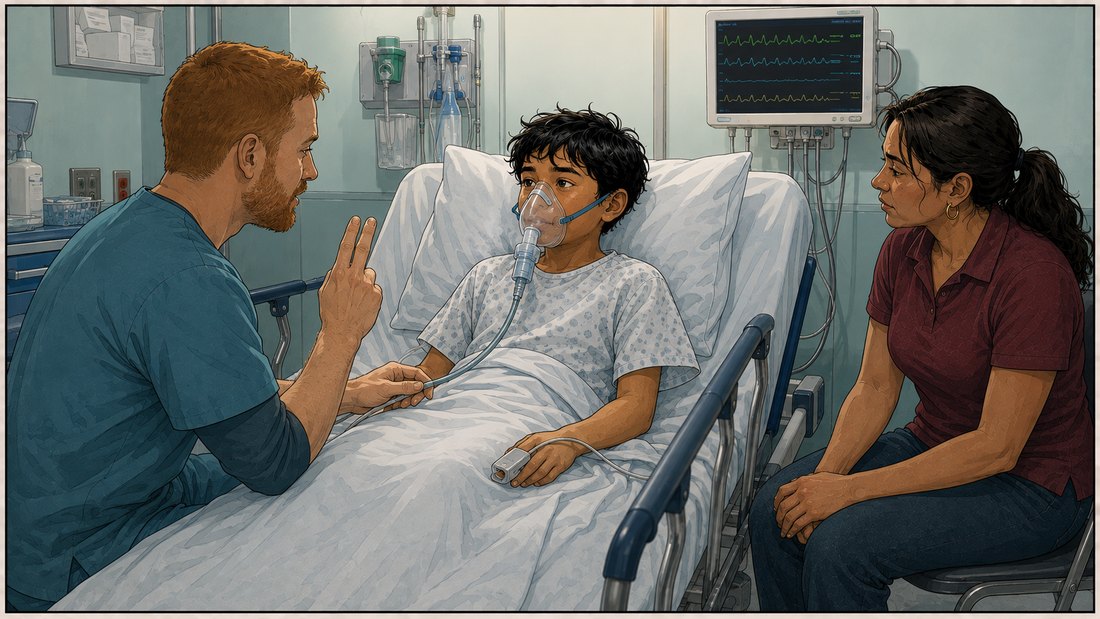
At two in the morning, Rosa wakes her mother to watch Lily and drives Andre to the emergency department at the children’s hospital. In the waiting room a nurse takes one look at Andre working to breathe and moves him straight back. Within minutes he is getting oxygen and a nebulizer treatment, a mask that turns medicine into a mist he can breathe in. A respiratory therapist stays at his side, coaching him, watching a number on a little clip on his finger climb slowly back up.
Two in the morning, and the streetlights still wearing halos of smoke. Comic panel illustration, AI-generated.
The nurse takes one look and moves him straight back. Comic panel illustration, AI-generated.
A mask that turns medicine into mist, and someone at eye level counting the rhythm. Comic panel illustration, AI-generated.
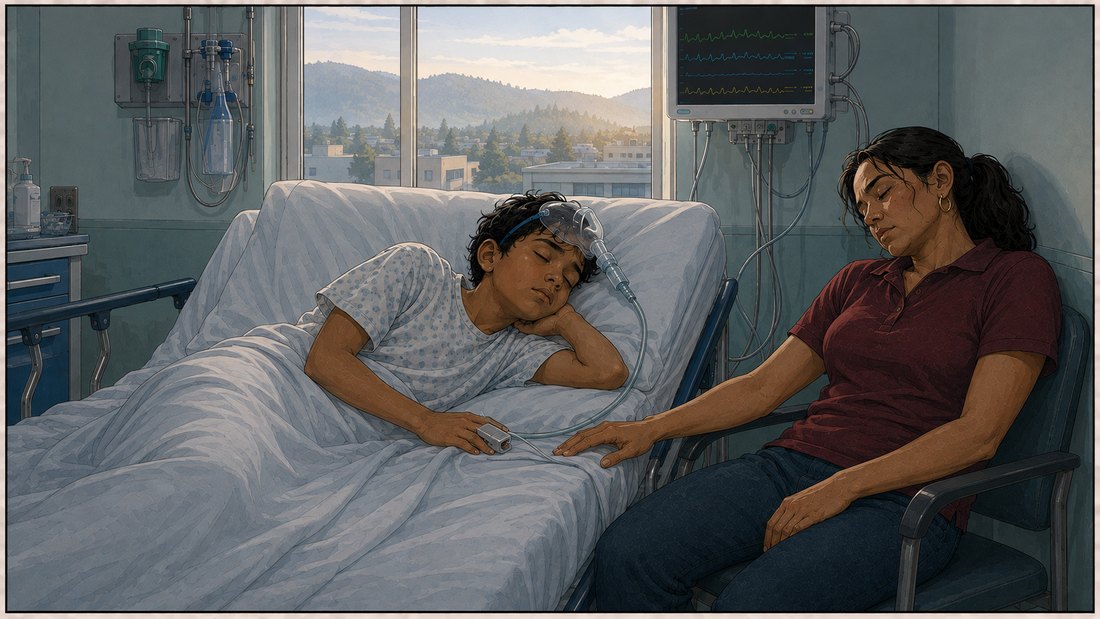
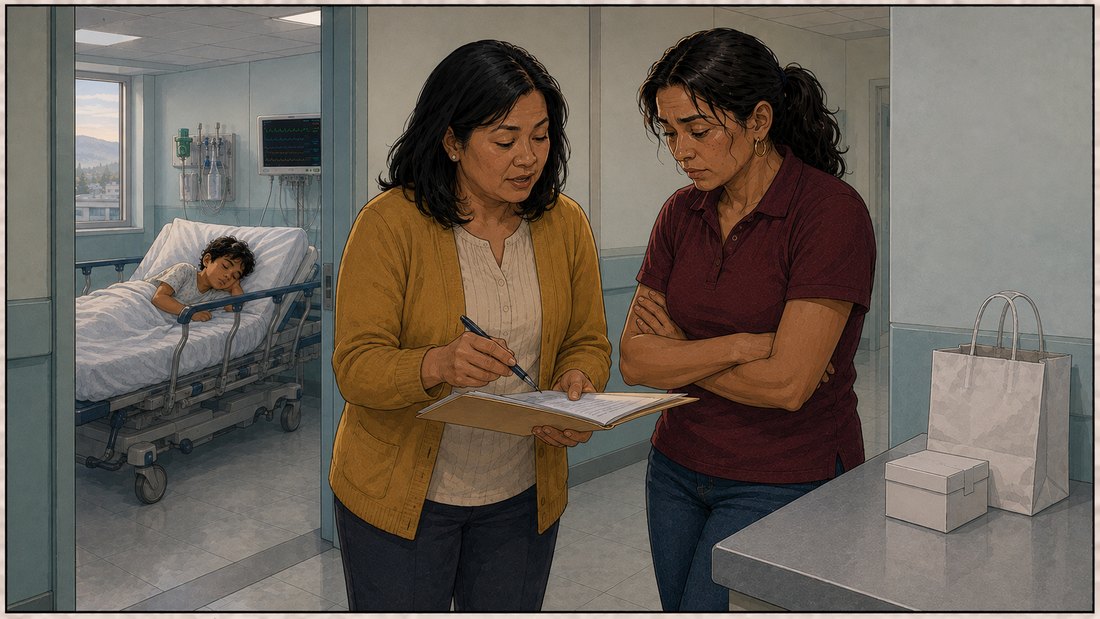
By dawn Andre is breathing easier. The emergency team gives him a course of steroids to calm the inflammation, refills his controller inhaler, and, crucially, does not just send him home with a prescription. A social worker comes to talk with Rosa. A referral goes out to a community program. Someone mentions a specialist. This is the moment Andre’s story stops being only about one bad night and starts being about the whole system that surrounds a child who cannot breathe.
By dawn he is breathing easier, and the hills are visible again. Comic panel illustration, AI-generated.
The visit does not end at the door. This conversation is where the rest of the case begins. Comic panel illustration, AI-generated.
What is happening here
Andre’s emergency was treatable, and he will be fine. But this same night is playing out in emergency departments across the region every summer, more often in neighborhoods like his. A single visit is the visible tip of a much larger story about air, housing, heat, and who is exposed to them.
A lens for your journey
From here, Andre’s journey moves outward in rings. First the people who touched him directly this week. Then the wider care team who follow him home. Then, in the outermost ring, the scientists and planners and advocates whose work decides what next summer’s air will be like. Every one of them is a possible future for you.
Next summer's air is already being decided, by people Andre will never meet. Comic panel illustration, AI-generated.
The chain, from the sky to his chest
The four rings sort people by how close they stand to Andre. This case has a second way of sorting them, and it runs the other direction: where on the chain of causes does your work sit? You will see these five badges on the stops ahead; tap any badge for a reminder.
Fire & HeatWhy the exposure exists at all: the fires, the climate, the bare pavement.
Why the exposure exists at all. Forests, fire policy, a warming region, and a street with no trees on it. The slowest work in the case, measured in decades, and the only work that reduces how often the air turns dangerous.
The AirMeasuring it, forecasting it, warning about it, and making rules about it.
Measuring it, warning about it, governing it. Sensors on rooftops, the purple square on Rosa’s phone, the studies that prove what smoky days do to children, the alerts, the cooling centers, and the money that follows.
The HomeThe building and the household standing between the outside air and the child.
The building between the air and the child. A leaky window, mold in the bathroom, no air conditioning, a purifier in the corner, an electric bill, and everyone else breathing under the same roof.
The BodyKeeping the airways calm on ordinary days.
Keeping the airways calm on ordinary days. The controller inhaler taken every morning, the spacer held correctly, the written action plan, the breathing test, and the adults who notice a pattern before it becomes a crisis.
The CrisisThe night it goes wrong, and the hour that follows.
The night it goes wrong. Oxygen, a nebulizer mask, steroids, and a clinician who treats first and asks questions after. The most visible link in the chain, and the last one.
Part Two · The Journey
Walk Andre’s road, stage by stage
His road has five stages, all open, and it runs outward: from the emergency department, to ordinary days, to the apartment, to the whole city, to the fire on the horizon. Walk them in order to follow the chain, or jump wherever your curiosity points. At most stops you will make a call before you read a word.
Family & communityThe ring closest to him: Rosa, Elena, Lily, and the school where the pattern first showed. Direct clinical careThe people whose hands touch Andre: the emergency team, his pediatrician, the specialists who tune his plan. Extended care teamPeople who work on the conditions around him: the community health worker, the social worker, the home inspector. Systems, science & public healthThe outermost ring, working at a distance: the scientists, the health officer, the planner, the organizer, the analyst.
The end of Andre’s story, his next-summer epilogue, the chain challenge, and the whole ecosystem unlock when you finish Stage V, or skip ahead with the button above.
Epilogue
Next summer
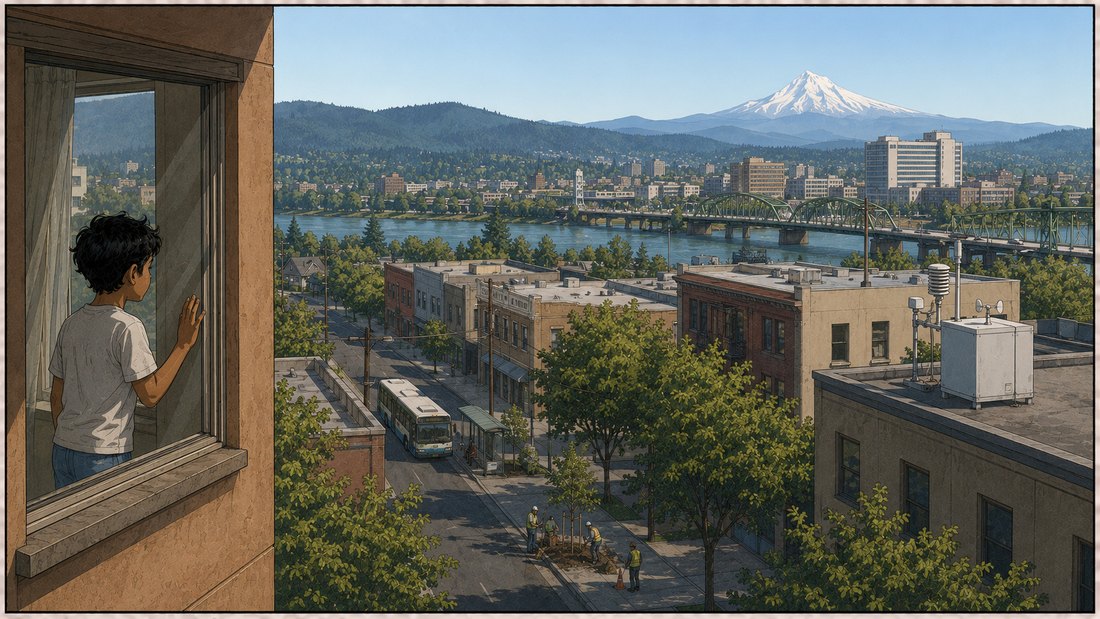
The same window, a year on. Twenty-three people stand behind this view. Comic panel illustration, AI-generated.
It is the following July, and the forecast is for another hot week. This time the apartment is ready for it. A window unit hums in the front room, paid for by a program Angela found and a letter Dr. Reyes wrote. A purifier runs in the corner of Andre’s bedroom. The window that let the smoke in has been sealed, and the bathroom has a fan that actually works, because Ray Delgado wrote it up and the county wrote it up as a repair order with a deadline on it.
On the refrigerator there is a chart with two inhalers drawn on it, one blue and one orange, and Andre can tell you exactly what each one is for. He takes the orange one every morning, including the mornings he feels fine, which took Karen three visits and a phone call to explain in a way that stuck. In the drawer under the chart there is a written plan with three colored zones and a line about what to do when the air quality index goes past 150.
He has not been back to the emergency department. He did have two hard days in June, and both times Rosa checked her phone, closed the windows, moved him and Lily and Elena into the front room with the purifier, and used the plan. That is the whole difference: the same air, and a family who now knows what to do about it.
On his block, six young trees went into the strip of bare curb in the spring. They are thin, staked, and no taller than Rosa. Nadia Petrov’s program put them there, and they will not shade anything for fifteen years. Andre will be twenty-four. If you want to know what it looks like to work on a child’s health at the pace of a lifetime, it looks like that.
Twenty-three people are in this story, and Andre has met nine of them. The other fourteen worked on his lungs from a distance, some of them without ever hearing his name.
The chain challenge
You met the five links before the journey. Now prove you can see them in the wild: here are six moments from Andre’s story. Sort each one into the link where the work is really happening.
The whole ecosystem
Here is everyone you just walked past, gathered into the four rings you saw drawn around Andre at the start. Click a name to revisit them.
Filled dots are people you have already met. Click any name to revisit them.
ANDRE, 9Our patient · Portland, Oregon
It took 23 people, and many more behind them, to help one nine-year-old breathe.
Now find your own direction
Look back at how far this story reached. One night in an emergency department connected to a school nurse, a pharmacist, a community health worker, an epidemiologist, a climate scientist, a fire ecologist, an urban planner, an organizer, and a policy analyst, and every one of them was part of helping Andre breathe. Which ring drew you in? The people in the room with the patient, the team who follows him home, or the outer world of science, systems, and change? There is no wrong answer, only your direction.